Origins
Ada Lovelace, the Jacquard loom, and the idea of a machine as an instrument.
“We may say most aptly, that the Analytical Engine weaves algebraical patterns just as the Jacquard-loom weaves flowers and leaves.”Ada Lovelace, Note A, 1843
“It is here interesting to observe the manner in which the value of an analytical resource is met and enhanced by an ingenious mechanical contrivance.”Ada Lovelace, Note F, 1843
Ada Lovelace
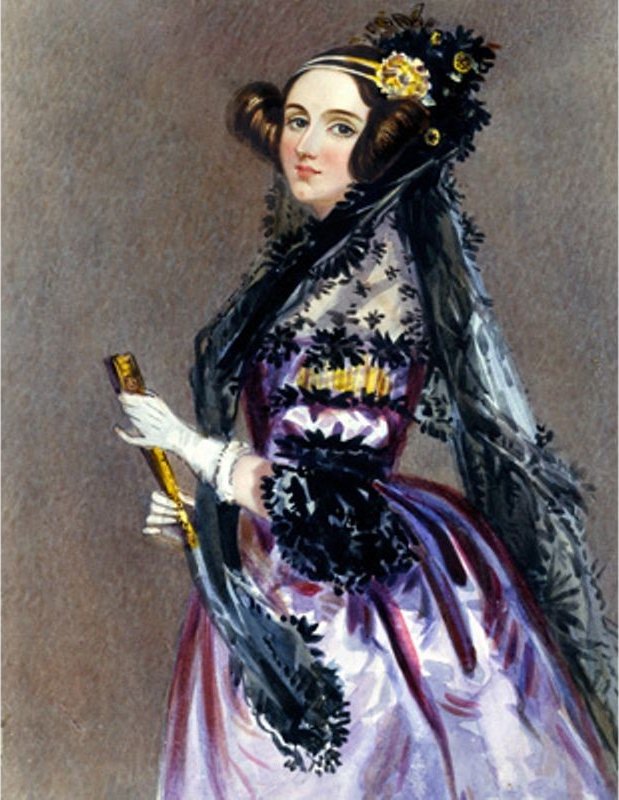
Ada Lovelace (1815–1852) was a mathematician, the daughter of the poet Lord Byron and Anne Isabella Milbanke.
In 1843 she published an English translation of a paper by Luigi Menabrea on Charles Babbage's Analytical Engine — a calculating machine Babbage designed but never built. She added her own Notes, lettered A to G, longer than the paper itself.
In them she saw that such a machine could work with symbols, not only numbers. Note G sets out how the engine could calculate Bernoulli numbers, and is often called the first published computer program.
The Jacquard loom
In the early 1800s Joseph-Marie Jacquard built a loom guided by a chain of punched cards. Each card decided which warp threads were lifted, so even very complex patterns could be woven, card by card. Babbage borrowed the punched cards for his engine — which is why Lovelace reached for the loom to explain it.
The story of a straight line from loom to computer is a simplification: weavers made patterned cloth with their own systems long before punched cards. We use it as an image, not a history.
An instrument, not a replacement
Lovelace imagined the engine making music: it “might compose elaborate and scientific pieces of music of any degree of complexity or extent” (Note A). An instrument gives a musician more than a voice alone can, and does not replace the musician. Collatorium asks people and AI models to work like that: each meeting the other's skills, and enhancing them.
Archives change
An archive is not fixed. Collections grow as new papers are found and given; they are reordered and recatalogued; paper fades, tears and decays. Collatorium treats each photograph as a record of the page at one moment — dated, kept, never altered — so new photographs, finds and readings can be set beside it.
Sources
L. F. Menabrea, “Sketch of the Analytical Engine invented by Charles Babbage”, translated with notes by A.A.L. [Ada Lovelace], Scientific Memoirs 3 (1843): Notes A and F — full text (Fourmilab).
“Lovelace [née Byron], (Augusta) Ada”, Oxford Dictionary of National Biography — doi:10.1093/ref:odnb/37253.